Elk Grove Township Property Tax Appeals: The Complete Guide
Whether you own a home in Arlington Heights, a condo in Mount Prospect, or a warehouse in the Elk Grove Village industrial park, the same basic system decides your Cook County tax bill — and the same right lets you challenge it. This guide explains how Elk Grove property taxes are calculated, where the township sits in the reassessment cycle, what wins an appeal for homes and for income property, and how to file.
reassessment cycle
(low for the county)
assessment level
appeal
The Short Version
- Your bill follows a formula: assessed value × state equalizer × local tax rate − exemptions. Lowering the assessed value is the part you can directly challenge.
- Elk Grove is reassessed every three years — most recently in 2025, next in 2028 — but you can appeal your value every year, not just reassessment years.
- Homes and income property win on different evidence. Houses and condos turn on comparable sales and accurate characteristics; commercial, industrial, and multi-family turn on income and expenses.
- Elk Grove's tax rate is on the lower end for Cook County — around 9% — thanks to the township's large commercial and industrial base.
- Two levels of appeal exist each year: the Cook County Assessor first, then the Board of Review. Don't forget your exemptions, which lower the bill separately.
Elk Grove Township covers Elk Grove Village, Arlington Heights, Mount Prospect, and Rolling Meadows — a mix of established residential neighborhoods, dense condominium developments, and one of the largest industrial parks in the country. That variety means tax appeals here look very different depending on what you own. Below is the full picture, for homeowners and business owners alike.
How Elk Grove Property Taxes Are Calculated
Every Cook County tax bill is built from the same formula:
A few things to know about each piece in Elk Grove:
- Assessed value. Residential property is assessed at 10% of the Assessor's estimated market value; commercial and industrial property at 25%. This is the number an appeal targets.
- State equalization factor. A multiplier (3.0355 for the 2024 tax year) the Illinois Department of Revenue applies countywide to keep assessments consistent across counties.
- Local tax rate. Set by the taxing bodies in your area — schools, the village, park districts, and others. Elk Grove's composite rate runs around 9%, lower than much of Cook County because its substantial commercial and industrial base shares the load.
- Exemptions. Subtracted near the end (Homeowner, Senior, and others). They don't change your assessment, but they reduce what you owe.
Because the assessed value flows through the whole calculation, even a modest reduction can produce meaningful savings — and it carries forward until the next reassessment.
Where Elk Grove Sits in the Reassessment Cycle
Cook County reassesses every township once every three years, on a three-section "triad" rotation — the City of Chicago, the south and west suburbs, and the north and northwest suburbs. Elk Grove is in the north/northwest group, most recently reassessed in 2025 and due again in 2028. In a reassessment year the Assessor sets a fresh value for every property; in the two years between, your value generally holds steady unless you appeal.
You Can Appeal Every Year
A common misconception is that you can only appeal in a reassessment year. Not so — Cook County lets you challenge your assessed value every year. A reassessment year is the strongest moment to act (the whole township is revalued at once), but in the "off" years you can still file and win a reduction. So even though Elk Grove's next reassessment isn't until 2028, you can appeal in 2026 and 2027 if your value looks too high. Track the township's current window on our deadlines page.
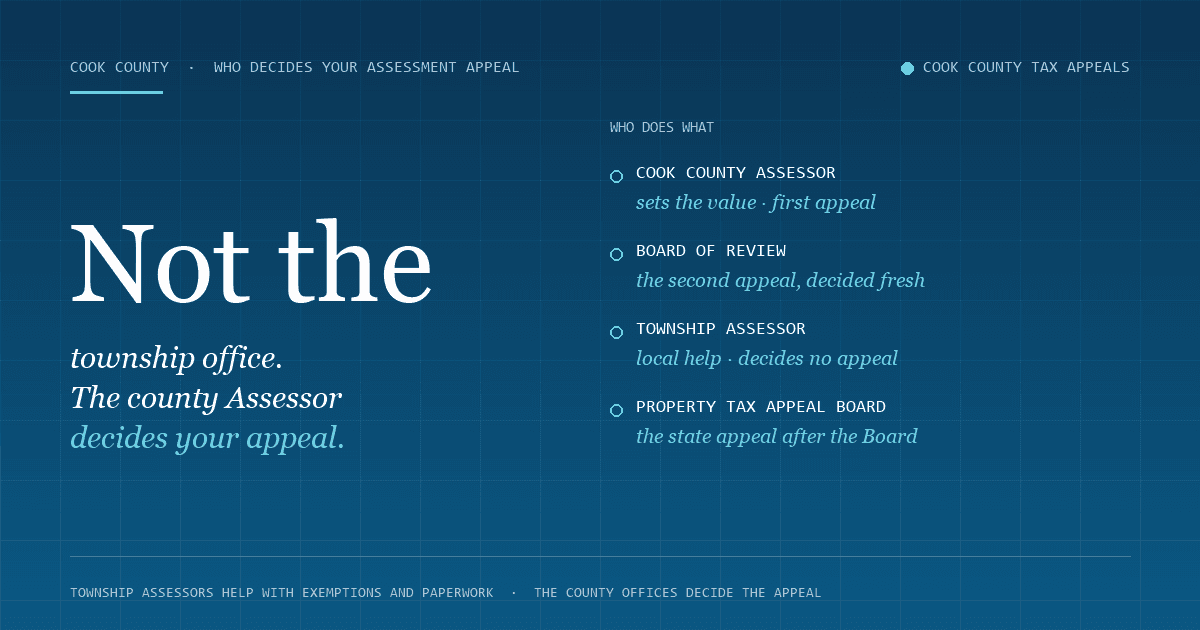
There are also two independent levels of appeal each year: the Cook County Assessor first, and then the Board of Review, a separate second look that opens after the Assessor closes. Many owners file at both.
Appealing a Home or Condo in Elk Grove
For residential property, a successful appeal usually rests on three arguments:
- Correct characteristics. Confirm the Assessor's record of your home — square footage, room and bath counts, age, and condition. A single wrong number can inflate your value.
- Comparable values. Show that similar nearby homes are valued lower, or that recent sales don't support your number. For condos, the strongest comparables are units within your own association.
- Uniformity. Even if your value looks defensible on its own, you may have a case if comparable homes are assessed more favorably than yours.
Condo owners deserve a special note: in Elk Grove, condominiums are the largest single group of filers but have historically had the lowest success rate, because their values are often set consistently building-by-building. The condo appeals that land lean on same-association sales and documented unit-specific differences — floor, view, condition — rather than broad neighborhood comparisons.
Appealing Commercial & Industrial Property
Income-producing property — the warehouses and plants of the Elk Grove Village industrial park, plus retail and apartment buildings across the township — is valued largely on the income approach: what the property earns drives what it's worth. That makes the strongest evidence financial rather than physical:
- Actual rents (the rent roll) — if the property earns less than the Assessor assumed, that gap supports a lower value.
- Operating expenses — real expense levels reduce net income, and net income drives value.
- Vacancy and collection loss — genuine vacancy or unpaid rent lowers effective income.
- Capitalization rate — the rate used to convert income into value; the right cap rate for your property type and risk can move the number significantly.
Because they're assessed at 25% of market value and tend to be larger, commercial and industrial properties often see the biggest dollar reductions in the township. Historically, income property in Elk Grove has won reductions far more often than homes or condos — see our Elk Grove 2025 appeal results for the detailed breakdown by property type.
What a Reduction Is Worth
Elk Grove's composite rate is modest by county standards, but reductions still add up — especially for larger properties:
Illustrative estimates using Elk Grove's state equalization factor (3.0355 for the 2024 tax year) and a representative composite rate (~9%); excludes exemptions and varies by tax code.
Don't Overlook Exemptions
Exemptions are separate from appeals and reduce your bill directly. Make sure you're receiving every one you qualify for:
- Homeowner Exemption — for owner-occupied homes.
- Senior Citizen Exemption — for owners 65+.
- Senior Freeze — freezes the assessed value for income-qualified seniors.
- Veterans and Persons with Disabilities — additional exemptions for those who qualify.
You can appeal your assessment and claim exemptions — they work together to lower what you owe.
How to File an Elk Grove Appeal
- Find your PIN and current assessed value on the Cook County Assessor's website or your most recent notice.
- Check your details and gather evidence — comparable sales and accurate characteristics for a home; rent roll, leases, and operating statements for commercial or industrial property.
- Confirm your window on our deadlines page — Cook County opens townships on a rolling schedule, and the windows are short.
- File with the Assessor, then with the Board of Review if the Assessor doesn't lower your value.
Not sure whether your assessment is out of line? Start with the signs your property is overassessed.
See What Your Elk Grove Property Could Save
Enter your address or PIN to compare your assessment against similar Elk Grove properties and check your current appeal window — no upfront cost, you only pay if you save.
Check My AssessmentElk Grove Township Appeal FAQ
Is 2026 a reassessment year for Elk Grove?
No. Elk Grove is in the north/northwest triad, reassessed in 2025 and again in 2028. But you can still appeal in 2026 — Cook County allows an annual appeal every year, not only in reassessment years.
How is my Elk Grove tax bill calculated?
Assessed value × state equalization factor (3.0355 for 2024) × local tax rate (~9% in Elk Grove) − exemptions. Residential property is assessed at 10% of market value, commercial and industrial at 25%. An appeal targets the assessed value.
What's the difference between appealing a home and a commercial property?
Homes and condos are argued mainly on comparable sales and accurate property characteristics. Commercial, industrial, and multi-family property is valued on the income approach, so the strongest evidence is financial — rent roll, expenses, vacancy, and the right capitalization rate.
Why do condos in Elk Grove win less often?
Condo values are often set consistently building-by-building, which leaves less room to argue a single unit is mispriced. The most effective condo appeals use sales within the same association and documented unit-specific differences rather than broad neighborhood comparisons.
Can I appeal and claim exemptions at the same time?
Yes. Appeals lower your assessed value; exemptions (Homeowner, Senior, Senior Freeze, Veterans, Disabled Persons) reduce your bill separately. They work together, so use both.
Data & Sources
- Reassessment cycle: Elk Grove Township (Cook County) is in the north/northwest suburban triad, reassessed in 2025 and next in 2028. Annual appeals are available in non-reassessment years (firm township records).
- Assessment levels and formula: Illinois Property Tax Code — residential property assessed at 10% of market value, commercial and industrial at 25%; bill = assessed value × state equalization factor × local tax rate − exemptions.
- Tax-rate and dollar figures use Elk Grove's state equalization factor (3.0355 for the 2024 tax year) and a representative composite rate (~9%), which is on the lower end for Cook County; estimates exclude exemptions and vary by tax code.
- Property-type appeal patterns reference Elk Grove's 2025 reassessment appeal outcomes (Cook County Assessor Appeals dataset); see the linked Elk Grove 2025 results article for the detailed breakdown. All data is public and county-wide; no firm-specific results are stated.
Keep Reading
This guide covers Elk Grove Township property tax appeals in Cook County and is general information, not legal or tax advice. Assessment levels and the tax formula reflect the Illinois Property Tax Code; tax-rate and dollar figures are estimates that exclude exemptions and vary by tax code. Filing windows are set by the Cook County Assessor and Board of Review and change through the year on a rolling schedule — always confirm your current deadline before filing. Representation is subject to a written engagement agreement.