North Chicago Township Commercial Property Tax Appeal — Your Income Is the Argument
For commercial property in Chicago's near-north core — the Gold Coast, River North, Streeterville, and the Magnificent Mile corridor — your assessment should follow what the property earns, not a mass-appraisal model. North Chicago Township was reassessed in 2024, and in that reassessment commercial owners won an exceptional 64.2% of appeals. Here's how income property is valued, what wins, and how to file.
won (2024)
AV reduction
filed (2024)
cycle
The 60-Second Version
- Commercial property is valued on its income — so a documented income-and-expense case is the strongest argument for a lower assessment.
- In the 2024 reassessment, 64.2% of North Chicago commercial appeals won — 1,293 of 2,014 — among the strongest rates of any township.
- The dollars are large here. The average winning reduction was about $395,000 of assessed value, reflecting big downtown-adjacent buildings.
- Commercial is assessed at 25% of market value (versus 10% for homes), so each dollar of over-assessment costs more.
- Reassessed 2024, next 2027 — but you can appeal every year, and the 2025 annual round has already closed.
North Chicago Township is the dense near-north side of Chicago — the Gold Coast, River North, Streeterville, Old Town, the Near North Side, and Lincoln Park. Its commercial base runs from Magnificent Mile retail and River North offices and galleries to hotels and mixed-use buildings. For all of them, the principle behind an appeal is the same: an income-producing property should be assessed on what it actually earns. When the assessment outruns the income, that's the opening.
01 · The core ideaYour income is the argument
Homes are valued on comparable sales. Commercial property is different — it's valued primarily on the income approach: what the property earns, after expenses, capitalized into a value. That's why the most persuasive commercial appeal isn't about a neighbor's building; it's about your own operating numbers. If your net operating income doesn't support the Assessor's value, you have a case.
02 · What the data showsWhat the 2024 reassessment showed for commercial owners
North Chicago's 2024 reassessment produced exceptionally strong commercial results. Across all commercial filings, 64.2% won a reduction — 1,293 of 2,014 appeals — with an average winning cut of about $395,000 in assessed value. The success rate varied by building type:
| Class | What it generally represents | Appeals | Success |
|---|---|---|---|
| 5 | All commercial (Class 5, overall) | 2,014 | 64.2% |
| 5-99 | Commercial condominium | 720 | 87.2% |
| 5-97 | Special commercial structures | 351 | 53.6% |
| 5-92 | Two-or-more-story commercial | 178 | 39.3% |
| 5-17 | One-story commercial | 113 | 32.7% |
A large share of filings here are commercial condominiums (Class 5-99) — common in downtown-adjacent high-rises — and they won at a very high rate (87.2%), which lifts the overall number. Traditional commercial classes still won solidly on their own.
03 · The 25% factorWhy commercial assessments cost more
Cook County assesses commercial and industrial property at 25% of market value, compared with 10% for homes. That higher ratio means a commercial over-assessment translates into a much larger tax bill — and a successful appeal returns proportionally more. On a property the Assessor pegs at $2,000,000 in market value, the assessed value is $500,000; trimming the market value by 15% removes $75,000 of assessed value, which flows through the equalizer and tax rate into real annual savings.
04 · What winsWhat actually wins a commercial appeal
- Income and expense data (the strongest evidence). Your rent roll, operating expenses, and vacancy — ideally on the County's RPIE-style format — let the Assessor recalculate value on your actual numbers.
- Overvaluation versus the market. Recent sales or appraisals of comparable commercial property that come in below the Assessor's implied value.
- Lack of uniformity. Similar commercial properties nearby assessed at a lower level per square foot than yours.
- Factual or classification errors. Wrong square footage, building type, or condition — including deferred maintenance and vacancy the mass-appraisal model didn't capture.
05 · What it's worthWhat a reduction is worth
North Chicago's composite tax rate runs around 6.6% — lower than the suburbs, as City of Chicago rates generally are. Here's how a commercial reduction flows through:
Illustrative estimate using North Chicago's state equalization factor and composite rate; excludes exemptions and varies by tax code. The average winning commercial cut here (~$395,000 of assessed value) is far larger — on the order of $79,000 a year — reflecting the size of downtown-adjacent buildings.
06 · When to appealThe deadline question: when can you file?
North Chicago is a City of Chicago township, reassessed in 2024, so its values were freshly set and generally carry forward until the next reassessment in 2027. Its 2025 annual appeal window has already closed. The key point: you can appeal every year, not only in reassessment years — so a too-high value can be challenged in the off-years too, which is especially worth doing if your building's income softened or vacancy rose.
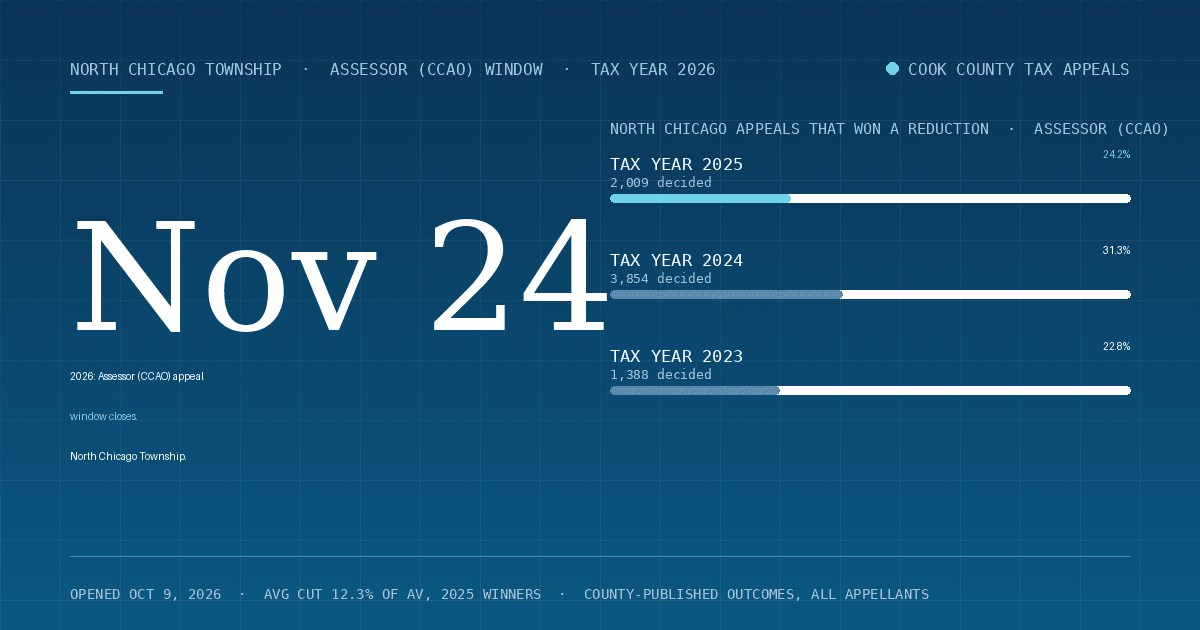
Each year there are two filing windows, on a township schedule: first the Cook County Assessor, then the independent Board of Review (where commercial cases often benefit from licensed representation). North Chicago's 2026 Assessor window runs October 9 to November 24, 2026 — confirm the current window before filing:
Check North Chicago's current appeal deadline here.
See What Your North Chicago Commercial Property Could Save
Enter your address or PIN to review your assessment and check your current appeal window — no upfront cost, you only pay if you save.
Check My AssessmentNorth Chicago Commercial Appeal FAQ
How are commercial properties valued for a North Chicago appeal?
Primarily on the income approach — net operating income (rent minus vacancy and expenses) divided by a capitalization rate. The strongest appeals present your actual income-and-expense data to show the Assessor's value is too high.
How did commercial owners do in North Chicago's 2024 reassessment?
64.2% of commercial appeals won a reduction — 1,293 of 2,014 — with an average winning cut of about $395,000 in assessed value. Commercial condominiums (Class 5-99), a large share of filings here, won at 87.2%, lifting the overall rate; traditional commercial classes still won solidly.
Why are commercial taxes higher than residential?
Cook County assesses commercial and industrial property at 25% of market value, versus 10% for homes. That higher ratio makes an over-assessment more expensive — and a successful appeal proportionally more valuable.
When is the North Chicago appeal deadline, and can I file in an off-year?
It changes every year and is set by township; North Chicago's 2025 window has closed and its 2026 Assessor window runs October 9 to November 24, 2026. You can appeal every year, not just in reassessment years — first with the Assessor, then the Board of Review. Confirm the current window before filing.
Is this the same as the city of North Chicago in Lake County?
No. This covers North Chicago Township — near-north Chicago neighborhoods such as the Gold Coast, River North, Streeterville, Old Town and Lincoln Park, within Cook County. The City of North Chicago in Lake County is a separate municipality outside Cook County.
Data & Sources
- Commercial results: Cook County Assessor Appeals dataset (Cook County Data Catalog), North Chicago Township (code 74), tax year 2024 (reassessment) — commercial (Class 5) 2,014 appeals, 1,293 marked "Change" (64.2%), average winning assessed-value reduction ~$395,418.
- Selected commercial class detail (2024): commercial condominium (5-99) 87.2% on 720 (a large share of filings, which lifts the overall rate); special commercial (5-97) 53.6% on 351; two-or-more-story commercial (5-92) 39.3% on 178; one-story commercial (5-17) 32.7% on 113.
- Assessment level: Illinois Property Tax Code — commercial and industrial property assessed at 25% of market value (residential 10%). Bill = assessed value × state equalization factor × local tax rate − exemptions.
- Reassessment cycle: North Chicago is a City of Chicago township, reassessed in 2024 (next 2027), confirmed by appeal-volume spikes in 2021 and 2024. The 2025 annual round had a November 20, 2025 last-file date and has closed; its 2026 Assessor window runs October 9 to November 24, 2026. Annual appeals are available every year.
- Tax-saving estimates use North Chicago's state equalization factor (3.0300 for the 2025 tax year) and a representative composite rate (~6.6%); estimates exclude exemptions and vary by tax code. All data is public and county-wide; no firm-specific results are stated.
Keep Reading
This article covers commercial and industrial property tax appeals in North Chicago Township, Cook County (near-north Chicago), and is general information, not legal or tax advice. Results figures are drawn from public Cook County Assessor appeal data for tax year 2024 (reassessment); individual results depend on the property and the evidence presented. Tax-saving figures are estimates that exclude exemptions and vary by tax code. Filing windows are set by the Cook County Assessor and Board of Review and change through the year — always confirm your current deadline before filing. Representation is subject to a written engagement agreement.