Norwood Park Township 2025 Appeal Results: 18.7% of Home Appeals Won — Commercial Led, Condos Lagged
In Norwood Park Township's 2025 reassessment, 477 of 2,549 homeowner appeals at the Cook County Assessor won a reduction — a success rate of 18.7%, counting each appeal once — and assessed values fell by roughly $6.1 million across all property types. Commercial owners and homeowners did reasonably well, but condo appeals won just 2 of 17.
success rate
(2025)
value reduced
success rate
The Short Version
- 18.7% of homeowner appeals won a reduction — 477 of 2,549, counting each appeal once — in Norwood Park's 2025 reassessment.
- Assessed values fell about $6.1 million in total across the winning appeals of every property type; the average winning appeal cut its assessed value by about 8%.
- Commercial owners won 43.4% and single-family homeowners 18.8% — but condo appeals won just 2 of 17, a stark gap.
- Norwood Park is a small township (Norridge and Harwood Heights), so some categories have limited filings — read the smaller groups as directional.
- 2025 was Norwood Park's reassessment year (next 2028). Its 2026 annual window has already closed (it ran April 13 – May 26), but the Board of Review is a separate option and you can appeal every year.
Norwood Park Township is a compact, mostly residential pocket of the near-northwest county — the villages of Norridge and Harwood Heights, surrounded by the City of Chicago, with a commercial spine around Harlem Avenue and the Harlem Irving Plaza. The 2025 reassessment results follow a familiar Cook County shape: income property fared best, homes landed near the township average, and condos struggled. Here's the detail.
Overall Results
For the 2025 tax year — Norwood Park's reassessment year — the Cook County Assessor decided 2,549 homeowner appeals in the township, counting each appeal once (a condo building's units, decided together, are one appeal). Of those, 477 received a "Change" (the assessed value or classification was adjusted in the owner's favor), a success rate of 18.7%. Across the winning appeals of every property type, assessed values fell by roughly $6.1 million in total, and the average winning appeal cut its assessed value by about 8%.
A "No Change" outcome doesn't necessarily mean a property was fairly assessed. It often means the evidence didn't meet the Assessor's standard, the comparables didn't support a reduction, or the filing was missing key documentation.
Success Rate by Property Type
The township-wide average masks a wide spread — from 2 of 17 condo appeals to 43.4% for commercial:
| Property type | Appeals | Success | Avg AV cut (winners) |
|---|---|---|---|
| Single-family home (Class 2) | 2,532 | 18.8% | ~$3,660 |
| Condominium (Class 2-99) | 17 | 11.8% | ~$46,266* |
| Commercial (Class 5) | 129 | 43.4% | ~$54,959 |
| Multi-family (Class 3) | 40 | 85.0% | ~$34,647 |
Counted by appeal: the county decides a condo building's units, or a multi-parcel commercial filing, together, and each such case counts once. "Avg AV cut" is the average assessed-value reduction among winning appeals in each group; *the condo figure is two building appeals, so its cut is a building's. Condos (17 appeals) and multi-family (40 appeals) are very small samples, so their rates are directional only, not reliable benchmarks.
The Condo Paradox — Pronounced Here
Norwood Park shows one of the sharper condo gaps in the county: condo owners appealed 689 units, almost all of them building by building — 13 building appeals covered 685 units — and only 2 of the 17 condo appeals won. Condo values are typically set building-by-building using consistent internal data, which leaves little room for a single unit to argue it's mispriced relative to its neighbors. The condo appeals that succeed almost always lean on sales within the same association and documented unit-specific differences — floor, view, condition — rather than broad neighborhood comparisons. A generic condo filing here rarely moved the number.
Commercial Led — Income Property Wins More Often
The strongest robust result came from commercial property: 43.4% of commercial appeals won (56 of 129), with a large average winning cut of about $54,959 — reflecting the retail and commercial property along the Harlem corridor and around Harlem Irving Plaza. Income property is valued largely on what it earns, so a documented income-and-expense case — rent roll, expenses, vacancy, and the right capitalization rate — gives the Assessor concrete grounds to lower the value. Multi-family owners won an even higher share, but on just 40 appeals, so that figure is directional rather than a reliable benchmark.
Homes Landed Near the Average
Single-family homes — the bulk of the township at 2,532 appeals — won 18.8%, just above the homeowner average, with an average cut of about $3,660. For homes, the winning evidence is comparable sales and accurate property characteristics: confirm the Assessor's record of your home's size, age, and condition, and line up recent sales of similar nearby houses in Norridge or Harwood Heights.
What These Results Mean for You
- Reductions happen, but they're not automatic. About 1 in 5 homeowner appeals won, and the spread by property type is wide.
- Commercial owners have the strongest case to make — and the largest average cuts.
- Condo owners need a sharp, association-specific case. Just 2 of 17 condo appeals won, so a generic filing almost never lands.
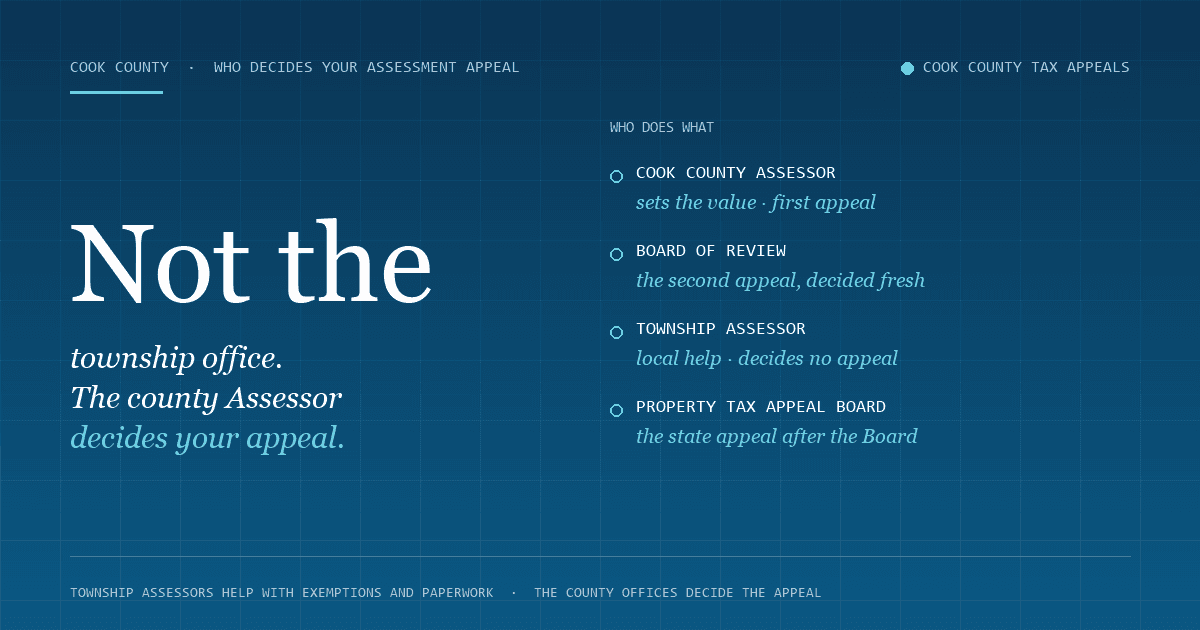
- Don't read "No Change" as the final word. The Board of Review offers a separate, second-level appeal after the Assessor.
You Can Appeal Every Year — Here's Where Norwood Park Stands
2025 was Norwood Park's reassessment year, so its values were freshly set and generally carry forward until the next reassessment in 2028. For 2026 — an annual (non-reassessment) year — Norwood Park's Assessor appeal window has already closed (it ran April 13 to May 26, 2026). The Board of Review's Norwood Park window closed too (it ran August 3 to September 1, 2026), so the next step is a fresh annual appeal in a future year. Cook County lets you challenge your assessed value every year, not just in reassessment years. Track Norwood Park's current window on our deadlines page.
For context on dollars: Norwood Park's composite tax rate runs around 8.6% (roughly 7.8–9.5% depending on the community). As a rough guide, a $5,000 assessed-value cut translates to roughly $1,300 a year in tax savings; a commercial reduction near the township average (~$33,800) can mean well over $8,000. Estimates exclude exemptions and vary by tax code.
See What Your Norwood Park Property Could Save
Enter your address or PIN to compare your assessment against similar Norridge and Harwood Heights properties and check your current appeal window — no upfront cost, you only pay if you save.
Check My AssessmentNorwood Park Township Appeal Results FAQ
What was the overall appeal success rate in Norwood Park for 2025?
18.7% of homeowner appeals — 477 of 2,549, counting each appeal once — received a "Change" (a reduction) in the 2025 reassessment. Across the winning appeals of every property type, assessed values fell by about $6.1 million.
Why did condos win so rarely?
Condo appeals won just 2 of 17 (11.8%); those 17 appeals covered 689 condo units, almost all of them filed building by building. Condo values are often set consistently building-by-building, which leaves little room to argue a single unit is mispriced. The strongest condo appeals use sales within the same association and documented unit-specific differences.
Which property types won most often?
Commercial owners won 43.4% (129 appeals, avg cut ~$54,959). Multi-family showed 85.0%, but on only 40 appeals, so that figure is directional. Single-family homes won 18.8%, just above the homeowner average.
Is 2026 a reassessment year for Norwood Park, and can I still appeal?
No — Norwood Park is in the north suburban triad, reassessed in 2025 and again in 2028. 2026 is an annual year, and Norwood Park's 2026 Assessor window has already closed (April 13 – May 26). You can still pursue the Board of Review, and you can file a fresh annual appeal in a future year.
If I received "No Change," can I appeal again?
Often, yes. Many owners appeal first with the Assessor and still have a second-level opportunity through the Board of Review, and you can file again in a future year. Confirm the current window before filing.
Data & Sources
- Appeal outcomes: Cook County Assessor Appeals dataset (Cook County Data Catalog), Norwood Park Township (code 26), tax year 2025, counted by appeal (each case once: a condo building's units or a multi-parcel filing, decided together, are one appeal) — homeowner appeals (Class 2) 2,549, 477 marked "Change" (18.7%). Across all property types, 2,720 appeals and 568 wins; the average winning appeal cut its assessed value by about 8%. Total assessed-value reduction across winning appeals ~$6.1 million.
- By property type (2025): single-family (Class 2) 2,532 appeals, 18.8%, avg winning cut ~$3,660; condominium (Class 2-99) 17 appeals (13 of them building appeals covering 685 units), 2 won, ~$46,266 per winning appeal; commercial (Class 5) 129 appeals, 43.4%, ~$54,959; multi-family (Class 3) 40 appeals, 85.0%, ~$34,647 (very small sample — directional only).
- Reassessment cycle: Norwood Park is in the north suburban triad, reassessed in 2025 (next 2028). The 2026 annual Assessor appeal window ran April 13 – May 26, 2026 and is closed; annual appeals are available every year.
- Dollar estimates use Norwood Park's state equalization factor (3.0300 for the 2025 tax year) and a representative composite rate (~8.6%); estimates exclude exemptions and vary by tax code. All data is public and county-wide; no firm-specific results are stated.
Keep Reading
This article summarizes public Cook County Assessor appeal outcomes for Norwood Park Township for tax year 2025 and is general information, not legal or tax advice. Figures are drawn from public appeal data; the multi-family group is a very small sample and its rate is directional only. Individual results depend on the property and the evidence presented. Dollar figures are estimates that exclude exemptions and vary by tax code. Filing windows are set by the Cook County Assessor and Board of Review and change through the year — the 2026 Assessor window closed May 26, 2026, and Board of Review windows are set separately; always confirm your current deadline before filing. Representation is subject to a written engagement agreement.